What you can learn about what’s under your spot from a geophysical test in the UAE
Before they start working on a building site, most people look at it from the outside. But what about the stuff below it?
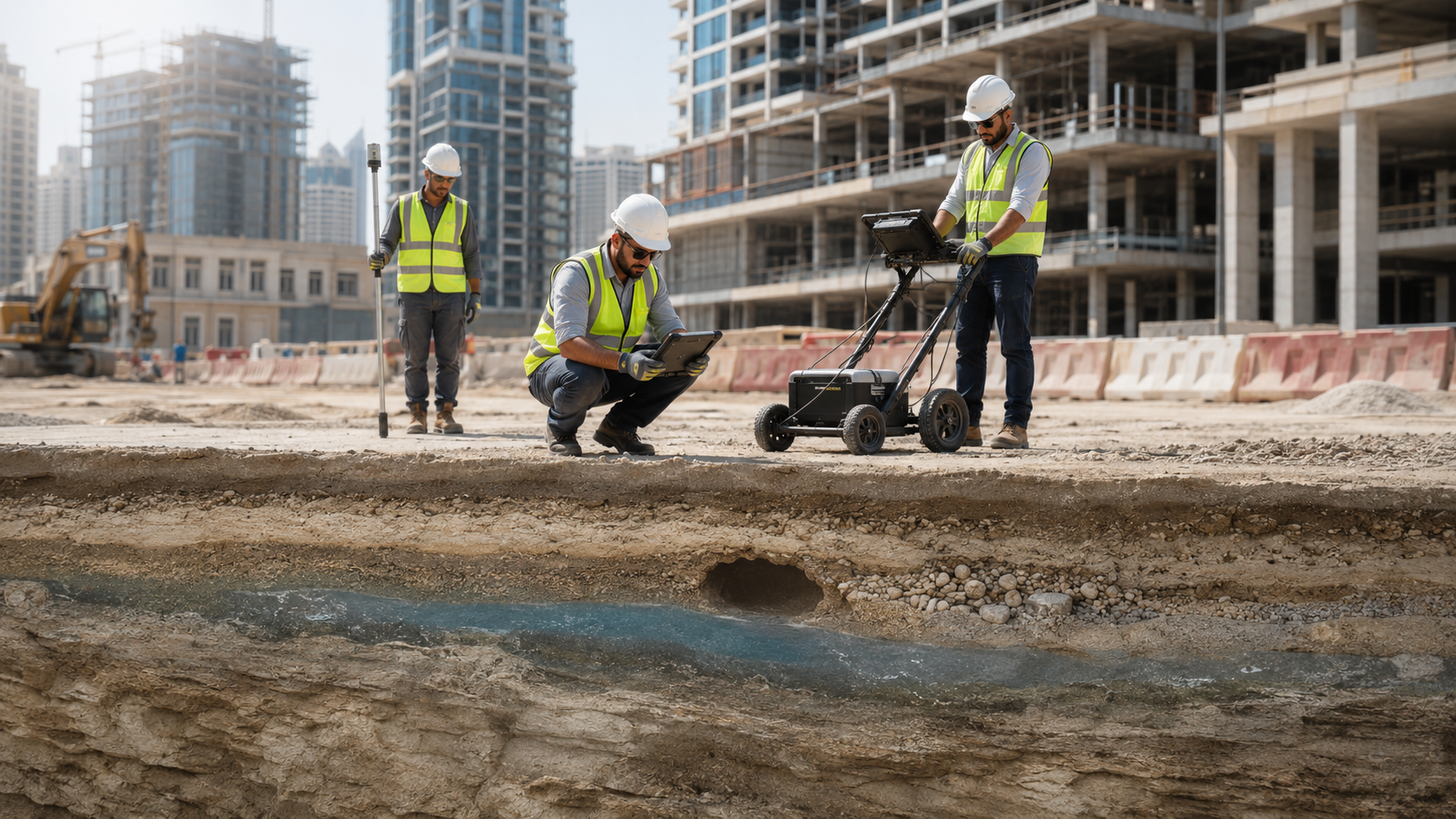
Below a building site, there might be holes, underground water, buried utilities, and other things that can’t be seen. There could also be different strata of rock and dirt. If they are not found early, these can sometimes cause problems that were not planned for during building.
Geophysical testing can help you learn more about what’s happening beneath the ground before you start building something big.
There are always new building and infrastructure projects going on in the UAE. Knowing what the ground is like can help with planning, make things safer, and make things more predictable.
What is a Geophysical Survey?
Seismic testing is a way to look into the ground without having to dig all the way up.
To send and measure messages through the earth, certain tools are needed. It helps scientists understand what is underground and any changes that may have happened in the rock, soil, groundwater, or anything else under the ground.
Before you start building, it’s like getting a better “picture” of the ground.
People who work as builders, architects, engineers, and developers can use this data to choose better projects.
Why does the ground under your site matter?
Things may look fine on the outside, but they may be very different on the inside.
There can be
Different amounts of dirt and rock
Soft or weak ground
The ground
A hole or space in the ground
Rock that is broken or worn
Hidden pipes and wires
How the ground feels at different levels
You can better plan the project if you find these conditions early on than if you find a problem while the building is going on.
How the ground feels at different levels
Earth-based tests are mostly used for one reason:
To help you learn more about the land before you decide to build something big.
You can: If you know more about what’s under the ground,
Find any problems that might be buried as soon as you can.
Help with building plans and the base.
Cut down on construction delays that aren’t planned.
Make better plans for your digs.
Find some things that are hidden.
Find out how the rocks and dirt change over time.
More geotechnical studies should be done.
Learn more to make better professional decisions.
You can’t use it instead of some types of site investigations, but it can help you fill in the blanks with useful information.
What kinds of tests are done on the ground?
Every job calls for a different set of skills. That’s the reason why there isn’t a single way to check for natural conditions everywhere.
Falcon Laboratory LLC can use different approaches based on the project and the data that needs to be collected.
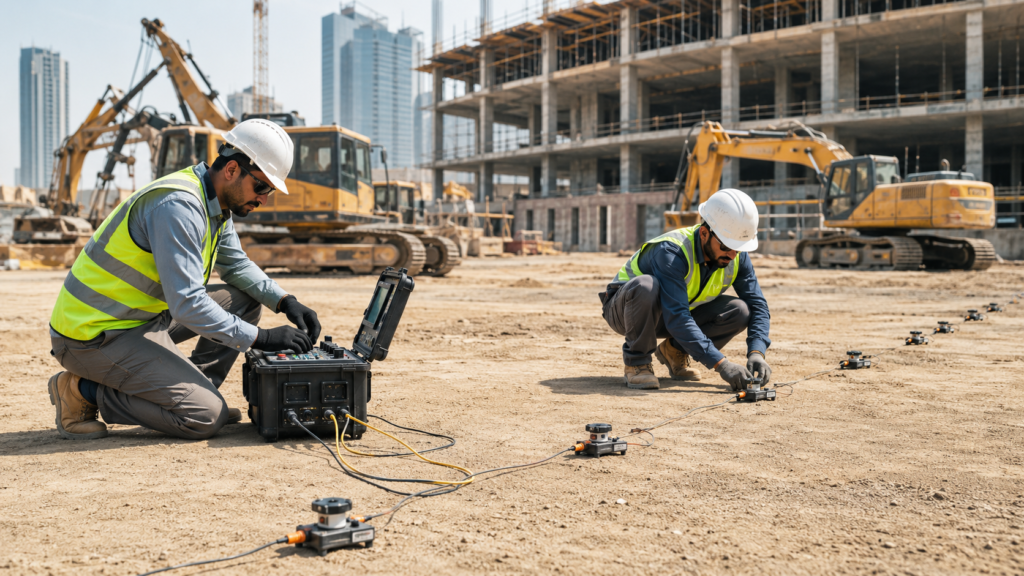
Ground Stiffness Estimation Using MASW Testing: Many-Channel Analysis of Surface Waves (MASW) provides information to engineers on the stiffness of the ground at various depths.
It can tell you what the ground is likely to do in response to building and structural loads and how the layers of dirt and rock have changed over time.
In other words, MASW helps answer:
“How does the ground change as we go deeper?”
Cross-hole earthquake testing: a better look at the ground
They drill deep holes. They send seismic waves down the holes. They look at the features of rock and dirt at different depths.
“By looking at how the seismic waves travel through the ground, engineers can learn a lot about what lies beneath the surface and how firm the ground is.
This is very useful for big building and infrastructure projects which require a lot of details.
Through seismic down-hole testing, the conditions at different depths are checked.
Down-hole tests are used to measure the behavior of the seismic wave at different depths inside a borehole.
It is useful to learn how the ground changes as you go down from the top.
The data can be used to study earthquakes and to make engineering decisions for building projects.
How to Identify What’s Happening Under the Ground: Electrical Resistivity Tomography (ERT)
is a technique that uses electrical measurements to investigate what is going on underground.
It can be used to identify changes in the materials of the ground and can be useful for: The ground where soil and rocks meet, empty rooms, voids, broken places, and alterations. This is useful because ERT can scan a large area without having to dig down very far.
GPR can find things that are close to the surface.
Ground penetrating radar can help you locate small objects buried in the ground.
It can assist you in finding buried pipes, structures underground, voids, and other things under the surface. GPR can help you determine what might be beneath the work area before you drill, cut, or dig.
Why Do Things Differently?
If you only looked at a house from one window, you might not know what it was all about.
You might see some of it, but not all of it.
It’s the same for the ground.
One way of geology might be better for finding out how stiff the soil is, while another might be better for drilling into the ground or finding shallow features.
You might get a better picture of the site if you use more than one method at the same time.
Things like these are what make the best way to do something.
Things you should look for
How much you need to look into it
How big the site is
How the ground is right now
What kind of building work it is
Things that the project needs
What kinds of jobs can geophysical testing help with?
Geophysical tests can help a lot of different types of projects in the UAE.
Creating Jobs
Engineers can plan the base of a building before it’s made by learning about the ground. This helps them figure out what’s below the surface.
Roads and other building parts
Most of the time, infrastructure projects like roads, bridges, and tunnels take up a lot of land. There are geophysical methods that can be used to learn more about the ground in these places.
Plans for digging and building utilities
Finding possible lines and other features below the ground can help teams make plans for safer work before they start digging.
Plans for oil and gas
There are many ways that geophysical studies can help us use what’s below the ground for oil and gas.
Plans for the earth and water
ERT is one way to look into things below the ground, like water and other things.
Stone sites and mines
Geophysical testing can also be used to look at the conditions of the earth’s crust, which can also help plan projects.
When might it be a good idea to make scientific tests?
You don’t always need to wait until something goes wrong.
You might be able to do geophysical research before you start building if you need to learn more about the ground.
It could be useful if:
Plans are being made for a new building or piece of gear.
We don’t fully understand how the ground is at the spot.
In the area where you work, utilities are already buried.
You need to check out a large area.
There might be cracks, holes, or broken rock.
You need to know more about the water that’s below the ground.
You want to dig or drill.
Before the building starts, you want to lower the risk.
Tests that look at the ground may save time and money.
That is, in theory.
If things happen below ground that are unusual, it could mean more study, longer to build, changes to the plan, or other problems with the project.
For making decisions, you have more information now that you have looked at the site.
That doesn’t mean that geological tests can tell you everything wrong. Instead, it makes you feel safer and helps you learn more about the ground.
When you’re building something, it helps to know more about it before you begin.
Why should you choose Falcon Laboratory if you need geophysical tests in the UAE?
A geophysical survey is only useful if the investigation, data collection, interpretation, and reporting are all done well. That’s why it’s important to choose the right testing partner.
When people need to investigate a place, Falcon Laboratory LLC can help them with geophysical testing, surveying, and consulting.
The first thing we do is learn about the project. Then we pick the best geophysical methods to get the information you need.
We can help you decide whether you need a ground test, a test of the layers below, a larger site investigation, or ground conditions.
Learn about a site before you build one.
You can see roads and houses and other buildings outside.
The ground, on the other hand, says something different.
Geological tests can help you find information that is hidden.
Being aware of what’s below your site helps you make better plans, find issues faster, and give your tech team more data to help them decide.
If you are planning any major projects in the UAE, be it construction, infrastructure, utilities, or any other kind, you might want to take a look down.
Want to See How the Ground Is in the UAE?
Tell them what you need for your project, and they will help you figure out the best geophysical testing method for your site.