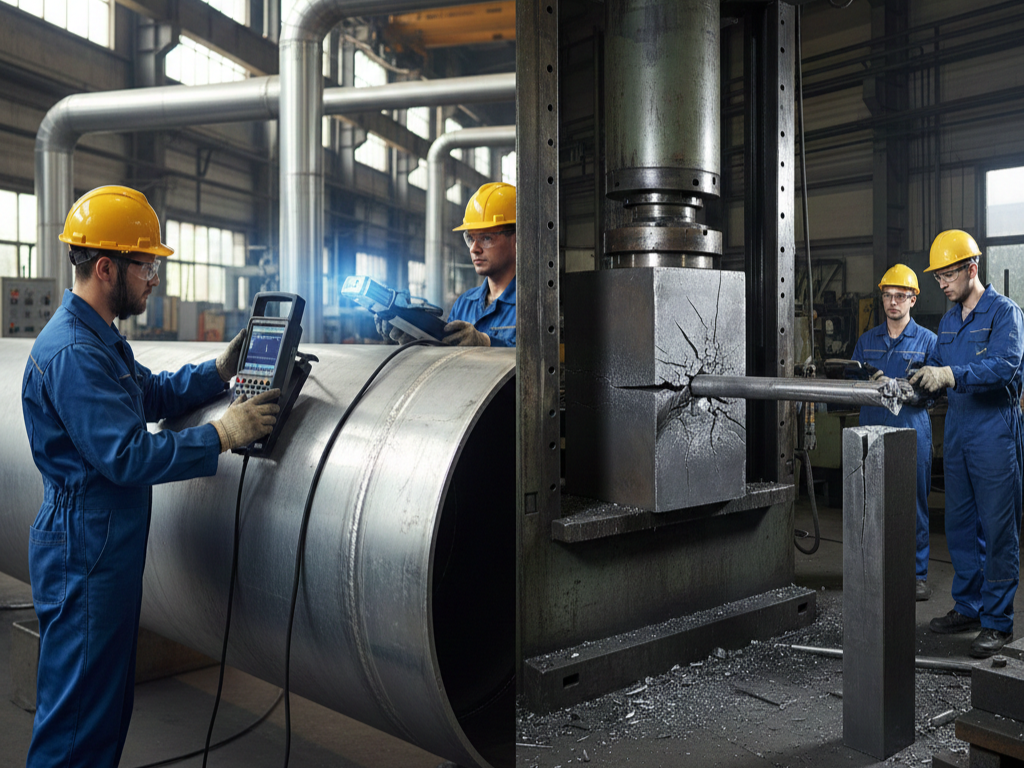
Key Differences Between Non-Destructive and Destructive Testing
Non-Destructive Testing vs Destructive Testing: Key Differences & When to Use Each
This article talks about two main ways to check the quality of materials: destructive testing (DT) and non-destructive testing (NDT). Both are necessary to keep buildings, machines, and pipelines safe and effective, but they do different things.
Being able to tell the difference can help you save time, money, and stress. Simply put, let’s break it down.
What is Non-Destructive Testing?
Non-destructive Testing is a way to check things out without breaking them. The thing can still be used after the test.
A health check-up for your gear, if you will. NDT can find problems like cracks, rust, or flaws in welds that aren’t obvious and fix them before they get worse. It does this without taking anything apart.
Typical NDT methods are:
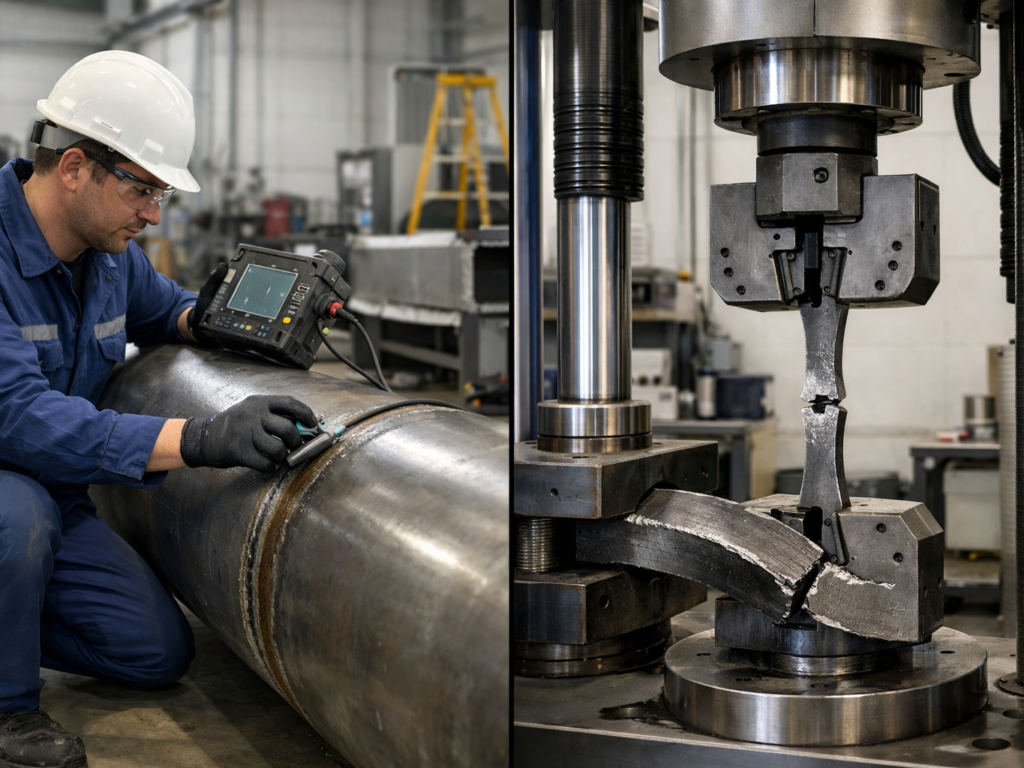
Sound waves are used in ultrasonic testing (UT) to find cracks that aren’t visible.
X-rays are used in radiographic testing (RT) to look inside metal or concrete.
MT, or magnetic particle testing, finds cracks in metals close to the surface.
With Liquid Penetrant Testing (PT), a special color is used to show off small cracks in the surface.
Visual testing (VT) is a simple check that can be done with the eyes or a camera.
Useful reasons:
You don’t hurt the tools.
You can check things out while they’re being used.
Plus, it saves you money and keeps you safer.
What is Destructive Testing?
This is not destructive testing. It puts things through their paces until they break or fail. You can’t use the sample again.
It’s like seeing how much weight a bridge can support—you have to push it very far to be sure it’s safe.
Normal DT methods are:
Tensile Testing finds out how much a substance can be stretched before it breaks.
It is tested for how much pressure it can withstand.
Bend testing checks how flexible and strong something is against bending.
Impact testing finds out how well a substance can handle shocks.
Hardness testing measures how hard something is to scratch or dent.
Useful reasons:
Details exactly how strong and long-lasting something is.
It helps make sure that products are safe and of good quality.
It helps with designing products and choosing materials.
Differences Between NDT and DT
Simply put, this is the main difference:
NDT: It looks for issues without hurting anything.
DT: Tears something to pieces to see how strong it is.
Other Differences: NDT is good for regular upkeep and checks.
A lot of the time, DT is done during the creation, certification, or testing of materials
Over time, NDT saves money
The DT method gives very exact strength data, but the sample has to be destroyed.
You should use either way; it depends on what you need to do.
When to Use Non-Destructive Testing
When your gear is already in use, like with pipes or tanks, non-destructive testing is the best.
You care about safety and want to avoid accidents.
To save money, you don’t want to buy replacements that aren’t needed.
Asset health needs to be checked on a daily basis.
You need to meet the rules set by the government without having to stop doing business.
NDT is all about making sure that your tools are safe, effective, and working well.
When to Use Destructive Testing
When you need precise information on strength or performance, destructive testing is the way to go.
You are checking out brand-new materials and goods before they are used.
You need to find out what went wrong.
To get certified, you need to show proof that you passed the test.
You’re making sure the plans work by putting them on models.
In DT, the goal is to find out how strong something is, even if that means breaking it.
Can NDT Replace DT?
Sure, but not really. They’re used for different things.
NDT is a great way to keep an eye on things and find issues without hurting them.
DT: Need to know the exact properties of the material and get certified.
They are both used together in most fields:
Decaying tests are used for design, approval, and material certification.
Nondestructive Testing is used to make sure things are safe, do repairs, and keep things in good shape.
Why Testing Matters in the UAE
Follow these steps to make your choice easy:
Don’t hurt anything when you check something out with NDT.
If you need accurate numbers regarding efficiency or strength, or if your certification requires them, use DT.
Most of the time, it’s best to do both at the same time. It’s possible to test something without breaking it, which can make sure it works right away and keep all that in good shape over time.
Making the Right Choice
Make your choice easily by following these steps:
Check something out with NDT if you don’t want to hurt it.
Use DT if you need exact numbers on performance or strength, or if your certification needs it.
Often, doing both at the same time is the best thing to do. Testing without damaging the material can make sure it works right away, and testing without damaging the material can keep everything in good shape over time.
Final Thoughts
Both destructive and non-destructive testing are important for quality, safety, and performance.
Things must be robust, durable, and good according to DT’s stringent regulations.
By using the correct method at the right time, businesses may reduce their risks, save money, and stay in compliance with the law.
Businesses in the UAE should foot the bill for NDT services because they have a responsibility to ensure the safety of their employees and customers.